
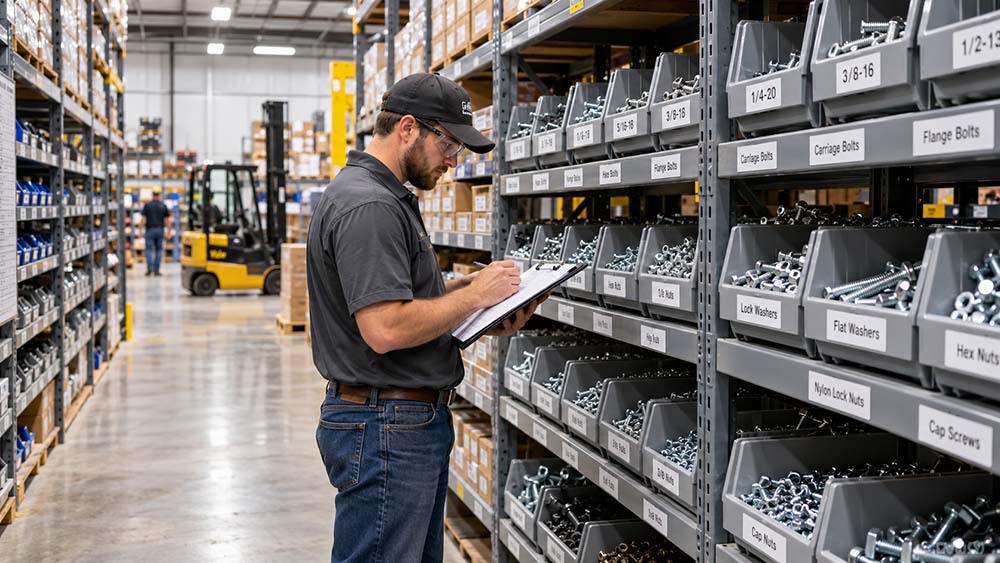
Fasteners may be small, but running out of the right bolt, screw, nut, washer, rivet, or other piece of hardware can bring an entire project, repair, or production line to a stop.
For construction companies, manufacturers, maintenance departments, automotive operations, fabricators, and other businesses that regularly use fasteners, inventory management is about much more than keeping shelves full. The goal is to have the right products available in the right quantities without tying up unnecessary money and warehouse space in items you rarely use.
A well-managed fastener inventory can help reduce downtime, control purchasing costs, improve productivity, and keep projects moving.
Here are eight ways businesses can improve how they manage their fastener inventory.
1. Identify the Fasteners You Use Most Often
Not every fastener in your inventory deserves the same attention. Start by identifying the bolts, screws, nuts, washers, rivets, and other hardware your company uses most frequently.
These high-use items should receive priority when establishing minimum inventory levels and reorder points.
Consider factors such as:
- How frequently the fastener is used
- Average quantity consumed
- How critical it is to operations
- How quickly it can be replenished
- Whether an acceptable substitute is available
A common fastener that is used every day may need a much larger safety stock than a specialty component required only a few times per year.
2. Standardize Fasteners Where Possible
One of the easiest ways to make fastener inventory unnecessarily complicated is to stock too many similar products.
Different departments, technicians, machines, or projects may specify slightly different hardware even when a more standardized selection could handle multiple applications.
Where engineering and application requirements allow, standardizing frequently used fasteners can reduce the number of individual products that need to be stocked.
This can simplify purchasing, reduce duplicate inventory, make organization easier, and potentially increase purchasing power by consolidating orders around commonly used items.
Of course, fasteners should never be substituted or standardized simply for convenience when strength, material, grade, finish, corrosion resistance, dimensional requirements, or other specifications require a particular product.
3. Establish Minimum and Maximum Inventory Levels
Ordering fasteners only when someone notices that a bin is almost empty is a recipe for shortages.
Instead, businesses should establish minimum and maximum quantities for important inventory items.
The minimum level indicates when it is time to reorder. The maximum helps prevent excessive purchasing and overstocking.
These levels can be based on factors including:
- Historical usage
- Upcoming projects
- Supplier lead times
- Seasonal demand
- Storage capacity
- Importance of the fastener to operations
Inventory levels should also be reviewed periodically. A fastener that was heavily used two years ago may no longer justify the same amount of shelf space today.
4. Don’t Wait Until You Run Out to Reorder
The worst time to discover you need a fastener is when a crew, technician, machine, or production line is already waiting for it.
The actual cost of a shortage can be far greater than the cost of the missing hardware.
A shortage can contribute to:
- Production downtime
- Idle employees
- Delayed repairs
- Missed project deadlines
- Expedited shipping charges
- Emergency purchasing
- Unplanned substitutions
Reorder points should provide enough time to replenish inventory before existing stock is exhausted.
5. Organize and Clearly Label Fastener Storage
Having a fastener somewhere in the building doesn’t help much if nobody can find it.
A good storage system should make commonly used hardware easy to identify and retrieve.
Bins, drawers, shelving, and other storage areas can be labeled with information such as:
- Fastener type
- Diameter
- Length
- Thread size and pitch
- Material
- Grade
- Finish or coating
- Internal part or inventory number
Clear organization also helps reduce the chance of accidentally using a fastener that looks similar but has different specifications.
6. Pay Special Attention to Critical and Specialty Fasteners
Some fasteners deserve special consideration even when they aren’t used frequently.
A specialty bolt that is required to repair a critical piece of equipment, for example, could be far more important than a common screw that is used hundreds of times per month.
When evaluating inventory, ask what would happen if a particular fastener wasn’t available when needed.
If the answer is that a project, machine, repair, or customer order would come to a halt, maintaining appropriate backup inventory may make sense.
Businesses should also consider lead times for unusual sizes, materials, grades, finishes, and custom or specialty products.
7. Review Slow-Moving and Obsolete Inventory
Fastener inventory tends to accumulate over time.
A product may have been purchased for a project that ended years ago. Equipment may have been replaced. Specifications may have changed. Yet boxes and bins of unused hardware can remain on the shelf indefinitely.
Periodically reviewing inventory can identify products that are rarely or never used.
This doesn’t necessarily mean every slow-moving item should be eliminated. Some may be critical spare parts that are intentionally kept on hand.
The important thing is knowing why you’re stocking an item rather than continuing to reorder it simply because it has always been there.
8. Build a Strong Relationship With a Knowledgeable Fastener Supplier
Inventory management doesn’t end at the warehouse door.
A knowledgeable fastener supplier can help businesses source both everyday and specialty hardware while providing guidance when a particular product is difficult to find or an application requires specific characteristics.
Working with a supplier that maintains a broad inventory can also simplify purchasing by reducing the need to source different categories of fasteners from numerous vendors.
When you need something unusual, having an established relationship with people who understand fasteners can be especially valuable.
Better Fastener Inventory Can Mean Better Business Operations
Fastener inventory management may not receive the same attention as major equipment, raw materials, or finished goods, but these small components can have an outsized impact on productivity.
The objective isn’t simply to stock more hardware.
It’s to stock smarter.
By understanding usage, establishing appropriate inventory levels, improving organization, reducing unnecessary duplication, planning for critical components, and working with an experienced supplier, businesses can reduce shortages while avoiding excessive inventory.
Allied Bolt & Screw: Helping Keep Your Fastener Inventory Stocked
Since 1961, Allied Bolt & Screw has supplied fasteners and hardware for construction, manufacturing, maintenance, automotive, fabrication, and a wide variety of industrial applications.
With an extensive inventory that includes bolts, screws, nuts, washers, rivets, threaded products, specialty fasteners, and much more, Allied Bolt & Screw can help businesses find the products they need to keep projects and operations moving.
Whether you’re replenishing frequently used hardware or searching for a difficult-to-find fastener, our experienced team can help you identify the right solution.
Need to replenish your fastener inventory or find a specialty item? Contact Allied Bolt & Screw today and let our knowledgeable team help you find the fasteners and hardware your business needs.


