
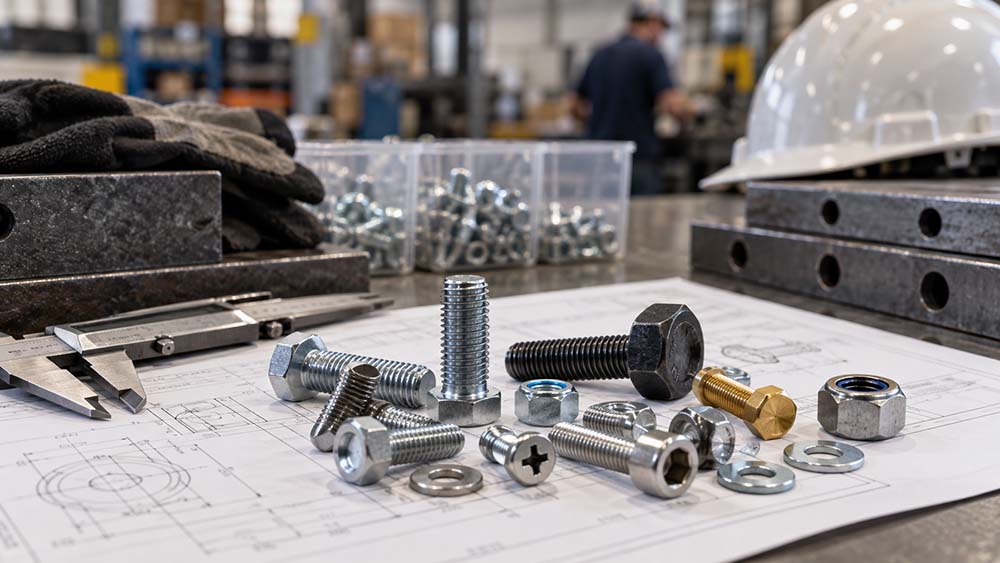
Fasteners may be some of the smallest components in a product, machine, building, or assembly, but choosing the wrong one can create surprisingly large problems.
A bolt that costs only a few dollars can contribute to equipment downtime, premature repairs, damaged materials, corrosion, installation problems, and even product failure. That’s why choosing a fastener shouldn’t simply come down to finding the right diameter and length.
Whether you’re purchasing fasteners for manufacturing, construction, maintenance, automotive applications, or general industrial use, avoiding these seven common mistakes can save your business time and money.
1. Choosing Based on Price Alone
Controlling costs is important, especially when purchasing fasteners in large quantities. However, the lowest-priced fastener isn’t necessarily the least expensive choice over the life of the application.
A cheaper fastener that wears prematurely, corrodes, loosens, or needs frequent replacement can quickly erase the initial savings.
Instead of looking only at unit price, consider the total cost of using the fastener, including installation, maintenance, replacement, labor, and potential downtime.
Sometimes spending a little more on the appropriate fastener can save considerably more later.
2. Using the Wrong Material
Steel, stainless steel, brass, aluminum, and other fastener materials each have different characteristics.
The correct choice depends on the application and environment.
Factors can include:
- Required strength
- Temperature
- Moisture exposure
- Chemical exposure
- Weight requirements
- Electrical conductivity
- Corrosion resistance
A fastener that performs perfectly indoors may perform very differently when exposed to weather, chemicals, salt, or extreme temperatures.
Selecting the material for the environment is just as important as selecting the correct size.
3. Ignoring Corrosion
Corrosion is one of the easiest fastener problems to underestimate.
Outdoor equipment, marine environments, industrial facilities, vehicles, HVAC systems, and equipment exposed to chemicals or moisture can all require additional corrosion protection.
Choosing the appropriate material, finish, or coating can significantly extend the service life of a fastener.
It’s also important to consider the materials being joined. Certain combinations of dissimilar metals can contribute to galvanic corrosion when moisture is present.
The fastener itself may be small, but corrosion-related damage can affect much more than the fastener.
4. Assuming Stronger Is Always Better
It might seem logical that the strongest available fastener is automatically the best choice.
That’s not necessarily true.
Fasteners are designed with specific grades, strength characteristics, and applications in mind. Using a higher-strength fastener than necessary can add unnecessary expense and, depending on the application, may introduce other considerations involving hardness, brittleness, installation, or the materials being joined.
The objective isn’t to use the strongest fastener you can find.
It’s to use the appropriate fastener for the application.
5. Overlooking Installation Requirements
The best fastener on paper isn’t necessarily the best fastener on the production floor or job site.
Think about how the fastener will actually be installed.
Does the installer have access to both sides of the assembly? What tools will be available? How quickly does the fastener need to be installed? Will it eventually need to be removed? Is installation manual or automated?
These questions can affect whether the best solution is a bolt, screw, rivet, rivet nut, or another fastening method.
When businesses purchase thousands of fasteners, even a small improvement in installation time can translate into meaningful labor savings.
6. Failing to Consider Maintenance and Service
Some assemblies may rarely need to be opened again. Others require regular inspection, maintenance, cleaning, or component replacement.
That difference matters when choosing fasteners.
A permanent fastening solution may make sense for one application while creating unnecessary work for another. Likewise, a fastener that’s difficult to access or remove can turn a simple maintenance task into a time-consuming repair.
Thinking about the entire lifecycle of the assembly, not just initial construction, can help prevent future headaches.
7. Treating Fasteners Like an Afterthought
This may be the biggest mistake of all.
Fasteners are sometimes selected near the end of the design or purchasing process because they’re viewed as simple commodity items.
But the right fastener can influence durability, installation speed, maintenance requirements, appearance, safety, and overall product performance.
The earlier fastening requirements are considered, the easier it is to select a solution that works efficiently and economically.
Small Parts Can Have a Big Impact
The price of an individual fastener may be tiny compared with the value of the equipment, product, structure, or assembly it’s holding together.
That’s exactly why selecting the right one matters.
A seemingly minor purchasing decision can affect labor costs, maintenance schedules, product reliability, inventory requirements, and downtime for years to come.
At Allied Bolt & Screw, we understand that customers don’t simply need nuts, bolts, screws, rivets, and other hardware. They need the right fastening solution for the job.
With a broad selection of fasteners and industrial hardware and decades of industry experience, Allied Bolt & Screw can help businesses find products that meet the requirements of their specific applications.
Need help finding the right fastener for your next project or application? Contact Allied Bolt & Screw today and let our experienced team help you find the right solution.


